

ACCRA — Customs clearance times are falling, freight costs are contracting on select routes, and certificates of origin are being issued at an unprecedented rate: the African Continental Free Trade Area (AfCFTA) is producing measurable logistical effects. They remain, however, localized, fragile, and inversely proportional to the ambition proclaimed.
THE STARTING POINT: A GEOGRAPHY OF EXCESS COST
Before assessing the gains, the structural baseline that preceded the agreement’s entry into force on January 1, 2021 must be established.
A joint UNCTAD-World Bank study (2023) quantifies non tariff trade costs in Africa as equivalent to a 292% tariff applied to the value of goods. This figure, derived from raw customs data, is not an abstraction: it reflects the cumulative weight of border delays, redundant procedures, divergent regulations between member states, and the physical condition of transit routes.
UNCTAD, in its 2024 Economic Development in Africa Report, notes that road transport accounts for approximately 29% of the final price of goods traded within the continent, compared to 7% for goods traded outside it. In other words, logistical enclosure alone constitutes an implicit tax four times above the international norm.
According to the African Development Bank (AfDB, 2023), road freight tariffs in Africa are twice as high as those in the United States, and transit times along critical export corridors are up to three times longer than in Asia.
The structure of the transport network compounds this assessment. Roads constitute the continent’s primary mode of transport, carrying 80% of freight and 90% of passenger traffic, yet only 43% of Africa’s main population has access to an all-season road, and just 53% of the network is paved, according to an AfDB report published at the Africa Investment Forum 2023.
PRE-AfCFTA: FRAGMENTATION AS THE NORM
Between 2010 and 2021, the decade preceding the agreement’s entry into force, comprehensive trade costs across Africa decreased by 7.3%, with non-tariff costs declining by 2.1%, according to Trade Mark Africa (TMA). A real improvement, but insufficient to close the gap with other regions.
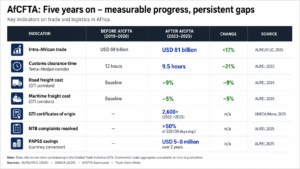
Intra-African trade remained structurally depressed. In 2019, intra-African trade stood at USD 69 billion, according to data compiled by ITUC-Africa and ALREI (2025). A level that, measured against the continent’s scale, 54 nations, more than one billion inhabitants, illustrates the depth of missed commercial integration.
The primary driver was not tariffs, but non-tariff barriers. At border posts, goods could remain immobilized for days awaiting clearance. Road, rail, maritime, and air transport systems operated in silos rather than as integrated logistics corridors, while overlapping regulations created cumulative administrative burdens.
POST-AfCFTA: WHAT THE DATA SHOW
Tema–Abidjan Corridor: The Reference Case
The Tema (Ghana)–Abidjan (Côte d’Ivoire) corridor is the most thoroughly documented test case for AfCFTA’s customs effects. Customs clearance times on this corridor fell from 12 hours to 9.5 hours, a 20.8% reduction, according to the ALREI impact report (2025) covering the period 2021, 2025. This improvement is directly attributable to joint interventions by the AfCFTA Secretariat and Trade Mark Africa (TMA) at the Akanu Noepe border posts (Ghana–Togo) and Noe-Elubo (Côte d’Ivoire–Ghana).
According to the statement delivered by Wamkele Mene, Secretary-General of the AfCFTA Secretariat, before the 57th session of the United Nations Economic Commission for Africa (UNECA, March 2025), joint field assessments along the Abidjan–Lagos corridor led to concrete infrastructure improvements at the relevant border posts.
Freight Cost Reduction: Real Gains, Limited Perimeter
On corridors where trade facilitation measures were deployed under the AfCFTA framework, logistics costs fell by 9% for road freight and 5% for maritime freight, according to the ALREI impact report (2025).
These figures must be read with caution: they apply to specific routes and do not constitute a generalized continental trend. UNECA and the AfDB have not yet published an aggregated intra African logistics cost index for the post-AfCFTA period that would enable a systematic before/after comparison at continental scale.
The PAPSS Payment System: A Quantified Forex Gain
The Pan-African Payment and Settlement System (PAPSS), deployed in pilot phase under the AfCFTA framework, generated savings of between USD 5 and USD 8 million in foreign exchange conversion fees over two years, according to the same ALREI data (2025). Currency intermediation costs represent, for small African exporters, a non-tariff barrier frequently rendered invisible in macro-level analyses.
The GTI as a Customs Laboratory
The Guided Trade Initiative (GTI), launched in September 2022 by the AfCFTA Secretariat, provides a basis for evaluating the agreement’s preferential effects under real commercial conditions. The number of certificates of origin issued under this framework rose from 13 in 2022 to over 2,600, according to the official statement by Wamkele Mene before UNECA in March 2025.
In July 2025, trade law firm Tralac reported that Tanzania had exported more than 14,000 tonnes of sisal fiber to 17 African countries under the GTI between May 2023 and December 2024, generating nearly USD 23 million in revenue.
Non-tariff barriers resolved through the AfCFTA’s dedicated reporting platform account for more than half of the 220 complaints logged, with an average resolution time of 39 days, according to ALREI (2025).
THE FACTUAL VERDICT: AN ASYMMETRIC IMPROVEMENT
What Has Progressed
The table below synthesizes available data:
What Remains Blocked
Available data do not permit a conclusion of generalized transport cost reduction at continental scale. Structural failings persist across three dimensions:
1. The physical infrastructure deficit
UNECA estimates that more than 60,000 km of critical road links require upgrading to accommodate the anticipated growth in intra African freight demand generated by the AfCFTA. The cost of this investment exceeds USD 24 billion, based on a median construction cost of USD 400,000 per kilometer for sub-Saharan Africa.
2. Inter-state regulatory inconsistency
Divergences persist in axle load regulations, transport permits, product standards, and customs procedures, operational costs that fall disproportionately on the SMEs the AfCFTA is designed to empower.
3. The trade finance gap
A trade finance gap estimated at approximately USD 100 billion continues to limit SME participation in regional trade, according to the AfCFTA 2024–2025 Implementation Report.
4. The inter-regional divide.
Central Africa records an annual infrastructure deficit of USD 38 billion that hampers trade flows, with landlocked least developed countries particularly penalized by weak digital and logistics connectivity, according to the ALREI impact analysis (2025).
PRIORITY CORRIDORS: STATE OF PLAY
Three axes currently concentrate the bulk of documented activity:
Lagos–Abidjan: This corridor is subject to active elimination of non-tariff barriers combined with reduced transit times and logistics costs, through the standardization of customs procedures and harmonization of technical certifications.
Dar es Salaam–Kampala: An East African corridor being progressively integrated into digital customs management systems. Available data do not permit conclusions on the magnitude of cost gains specific to this route.
Lobito Corridor (Angola–DRC–Zambia): The 560-kilometer Lobito railway corridor, financed by the United States, will connect inland copper producers to the Atlantic, reducing transport costs to Western markets and facilitating rail freight across Central and Southern Africa. It remains under construction.
Nigeria – AfCFTA Air Corridor: Nigeria launched an AfCFTA air corridor serving Kenya, Uganda, and South Africa. According to the Nigerian Minister of Industry, Trade and Investment, this corridor is projected to cut export logistics costs by 50 to 75%. These official projections remain to be validated by independent operational data.
QUANTITATIVE PERSPECTIVE: THE GAP BETWEEN POTENTIAL AND REALITY
UNECA projects a 28% increase in intra-African freight demand by 2030 driven by the AfCFTA, requiring, according to the same source, 2 million additional trucks and 100 vessels.
UNECA further projects a cumulative GDP gain of USD 450 billion for Africa by 2035 attributable to the agreement. These projections rest on general equilibrium models that incorporate substantial implementation of protocols still under negotiation, a premise that current operational data do not yet validate.
Intra-African trade represented 16% of the continent’s total trade in 2023, according to UNCTAD, compared to 69% for Europe, 59% for Asia, and 47% for North America. The agreement has produced measurable gains on identified corridors without yet altering the fundamental structure of continental trade.