
- A Changing Economic Geography
- Diversification Rather Than Replacement
- When Logistics Becomes More Than a Matter of Distance
- Red Sea Disruptions Remind Us That Geography Still Matters
- Asian Hubs: The Invisible Drivers of African Trade
- African Ports Are Repositioning Themselves
- Logistics Corridors Are Becoming Instruments of Power
- The Real Shift Is Industrial
- A New Equation for African Trade
For decades, geography appeared to dictate the routes of African trade. Raw materials extracted or cultivated across the continent naturally followed the shortest corridors to Europe. Rotterdam, Antwerp, Marseille and Valencia served as the main gateways for African exports, reflecting a legacy of colonial ties, long-established logistics networks and geographical proximity that helped keep transport costs low.
That logic has not disappeared. But it is no longer sufficient to explain exporters’ decisions.
Today, an Ivorian cocoa producer, a Zambian copper exporter, a Congolese mining company or a Mozambican gas exporter weighs its export destinations using a far more complex equation. Freight costs remain an important consideration, but they are now balanced against market size, demand stability, long-term contracts, opportunities for industrial processing and future growth prospects.
The real question is no longer: Which market is the closest?
It has become: Which market creates the greatest value?
A Changing Economic Geography
The shift in the world’s economic center of gravity has become one of the defining developments of the past two decades.
According to the African Trade Report 2025, Europe’s share of global trade declined from 38.9% in 2009 to 35.8% in 2023, while East and Southeast Asia’s share increased from 25.2% to 28.3% over the same period. Behind these figures lies a simple reality: the world’s principal industrial centers are now concentrated in Asia.
China, the ASEAN economies, South Korea, Japan and, increasingly, India account for a growing share of global value chains in electronics, shipbuilding, batteries, electric vehicles, industrial equipment and petrochemicals.
For Africa, this transformation fundamentally reshapes the logic of international trade.
The continent continues to export primarily hydrocarbons, minerals, metals and agricultural products. However, the world’s strongest sources of demand are gradually shifting toward Asia, drawing African trade flows in the same direction.
Diversification Rather Than Replacement
The notion that Africa is abandoning Europe in favor of China deserves careful qualification.
The latest evidence points less to a replacement of trading partners than to their diversification.
The European Union remains a major destination for many African economies, particularly for agricultural products, selected minerals, phosphates and manufactured goods.
At the same time, China has become an indispensable buyer of African oil, copper, cobalt, manganese and bauxite. India continues to expand its imports of African energy and raw materials. ASEAN economies are steadily increasing their presence across several industrial sectors, while Gulf countries are simultaneously expanding investments in African ports, energy infrastructure and logistics.
The African Continental Free Trade Area (AfCFTA) is gradually supporting this shift. In 2026, intra-African trade is projected to account for approximately 16% of the continent’s total trade. While still modest compared with other major economic regions, the figure reflects a steady diversification of African trade alongside global partnerships.
Although still modest compared with other major economic regions, this reflects a gradual diversification that complements rather than replaces Africa’s commercial ties with global partners.
In other words, Africa is evolving less toward dependence on Asia than toward participation in an increasingly multipolar global trading system.
When Logistics Becomes More Than a Matter of Distance
This transformation is equally visible across global shipping networks.
For many years, maritime routes linking Africa to Europe were the busiest and most frequent. Shipping companies prioritized north-south corridors serving historically European-oriented demand.
Asia’s rise has progressively reshaped this geography.
Major shipping lines now operate more direct connections between African ports and Asian logistics hubs. Exporters seek not only competitive transit times but also rapid access to regional distribution networks serving the broader Asian market.
In this new environment, geographical proximity has lost part of its traditional advantage.
A longer voyage may still make economic sense if the destination market offers larger demand, more stable contracts, stronger growth or greater product value.
Red Sea Disruptions Remind Us That Geography Still Matters
Recent crises have nevertheless demonstrated that maritime routes remain vulnerable.
Attacks on commercial shipping in the Red Sea have forced many shipping companies to bypass the Suez Canal by sailing around the Cape of Good Hope. These diversions extend transit times by several days, increase insurance premiums, require additional shipping capacity and raise overall logistics costs.
For many African exporters, this has highlighted that competitiveness depends not only on transport costs but also on the resilience of maritime corridors.
It has also reinforced the strategic importance of ports located along southern Africa’s major shipping routes.
Asian Hubs: The Invisible Drivers of African Trade
One of the most common mistakes is to analyze trade solely through the lens of importing countries.
A growing share of African exports actually passes through logistics hubs whose importance extends far beyond their domestic markets.
Singapore provides the clearest example.
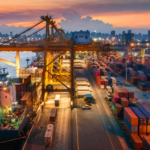
Its port ranks among the world’s leading transshipment centers. Containers arriving from Africa are redistributed to China, Japan, South Korea, Indonesia, Vietnam and the Philippines.
Port Klang in Malaysia and Colombo in Sri Lanka play comparable roles along several Indian Ocean–Asia shipping corridors.
These hubs are not necessarily the final destination for African goods.
They are the crossroads through which they pass.
Modern trade relies less on direct bilateral exchanges than on integrated logistics networks where a limited number of major ports handle a substantial share of global cargo flows.
African Ports Are Repositioning Themselves
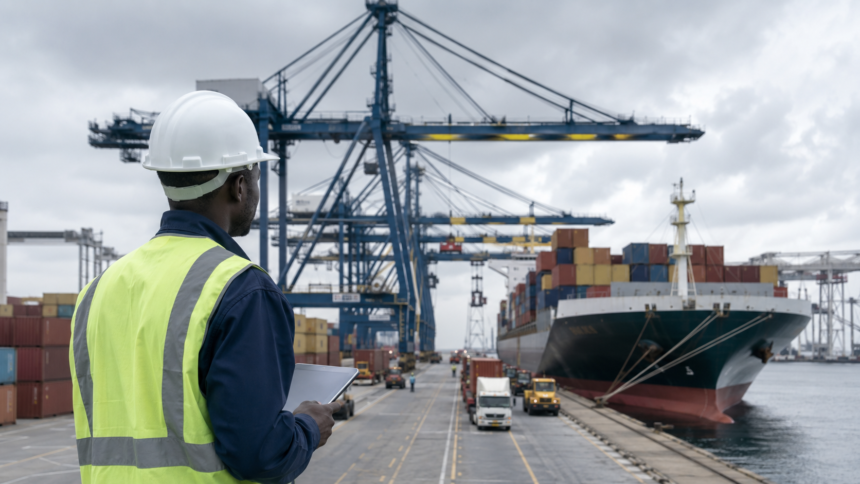
In response to these developments, several African ports are strengthening their strategic roles.
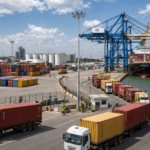
Tanger Med has become Africa’s largest container port and the leading container hub in the Mediterranean, thanks to its international connectivity and logistics performance.
The Port of Abidjan continues expanding its terminals, Tema is consolidating its position as a regional hub in West Africa, Mombasa is modernizing its infrastructure to better serve East Africa, while Durban remains southern Africa’s principal maritime gateway despite persistent congestion challenges.
All pursue the same objective: stronger integration into the major maritime routes linking Africa with Asian markets.
Logistics Corridors Are Becoming Instruments of Power
Beyond ports themselves, major land transport corridors are assuming growing strategic importance.
The Lobito Corridor, linking Angola, the Democratic Republic of the Congo and Zambia, aims to become one of the principal export routes for copper, cobalt and other critical minerals to global markets. Its development reflects efforts to secure supply chains essential to the global energy transition.
Across Eurasia, the Middle Corridor, which connects China and Europe through Central Asia, the Caspian Sea, the Caucasus and Türkiye, is also gaining importance amid disruptions affecting the Red Sea and traditional trade routes. Although it does not directly serve African exports, it contributes to the broader reconfiguration of global logistics networks into which African exporters are becoming increasingly integrated.
The Real Shift Is Industrial
Beyond changing trade routes, the most profound transformation concerns the nature of African exports themselves.
Guinea illustrates this evolution. Having become the world’s leading supplier of bauxite, the country is now seeking to expand domestic refining capacity in order to export more alumina, a significantly higher-value product.
Zimbabwe is pursuing a similar strategy in lithium by encouraging domestic processing before export.
The Democratic Republic of the Congo is seeking to attract investment into cobalt refining and battery materials, while Mozambique continues developing its liquefied natural gas industry to supply Asian markets.
Meanwhile, Morocco is steadily moving up the value chain in phosphates and fertilizers, with export markets remaining diversified across Europe, India, Brazil and Africa.
These examples illustrate a fundamental transformation.
Competition is no longer based solely on transportation costs. It increasingly depends on a country’s ability to integrate into global value chains. Ports, railway corridors, industrial zones and processing capacity have become just as strategic as natural resources themselves.
A New Equation for African Trade
African trade is entering a new era.
Geographical proximity has not disappeared. It has simply ceased to be the sole determining factor.
Exporters now make strategic choices between multiple markets, maritime corridors and logistics networks. Europe remains a major partner, but it now shares that space with China, India, the ASEAN economies, the Gulf states and Asia’s major logistics hubs.
The real transformation is therefore not merely geographical.
It is economic, industrial and logistical.
Africa is not simply redrawing its trade routes; it is gradually seeking to secure a stronger position within an increasingly multipolar global trading system.
Yet one question remains.
As long as the majority of African exports continue to consist of minimally processed raw materials, the destination of the ships may ultimately matter less than the nature of the cargo they carry.
That is where Africa’s true logistical, industrial and economic equation is likely to be decided over the coming decade.