
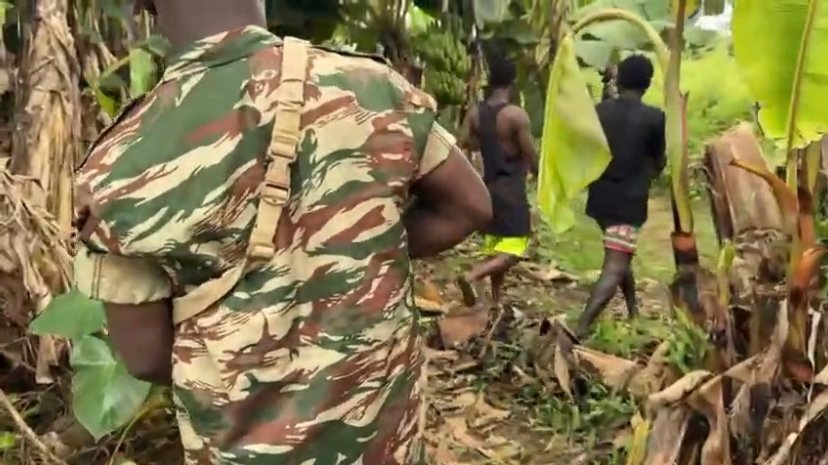

In Kumba, located in Cameroon’s Anglophone South West region, the ideals of independence have been swept away by the cynicism of profit. Caught in a vice between separatist factions turned cartels and corrupt law enforcement officers, the local population is subjected to a double taxation of terror. Our team went behind the scenes of this shadow business, where the line between rebel and soldier blurs behind the chime of mobile money transfers.
The road to Kumba no longer feels like an ordinary route. It is a journey through a gray zone, a space where traffic signs vanish, replaced by the law of the jungle. For The Lead Africa team, the warning came in the form of an unexpected ambush.
The armed separatists who intercepted our escort vehicle weren’t looking for our phones, nor the pocket change we had on us. They had a much more targeted objective: our data collection equipment. They didn’t want our money; they wanted to suppress the story.
Hours earlier, the official security forces escorting us had already shown signs of agitation, attempting to limit our investigative perimeter through physical pressure and tactical roadblocks. This double barrier, the rebels in the bush and the State on the tarmac, confirms a troubling truth: in this protracted conflict, information has become both the most valuable and the most endangered resource.
The New Faces of the “Cause”
To unlock Kumba’s secrets, it is not enough to listen to diaspora rhetoric. In the military barracks holding fighters captured by the Cameroonian army, the ideological veneer quickly peels away. We met Dominique and Emmanuel. Barely out of their teens, these two citizens turned combatants, fighting for a cause they themselves struggle to understand, don’t talk about politics or Ambazonian ideals. They talk about a trap.
They appeared out of nowhere. It was either enlistment or execution, Dominique recalls, his eyes darting away.
For these youths, choice never existed. The separatist movement, once driven by a wave of political protest, has fragmented into a myriad of decentralized micro-cartels. Cut off from structured funding, these groups had to reinvent themselves as predatory enterprises. Ransom kidnappings, highway extortion, and enforced urban lockdowns have become the pillars of a new economic model.

The contrast with what circulates on social media is striking. While the diaspora speaks of liberation, the reality on the ground reflects nothing but the brutal management of scarcity.
The Tyranny of the “Lockdown”
On October 1st, a symbolic day of independence, Kumba fell into the silence of “ghost towns” (villes mortes). For the separatists, this is not an act of political devotion; it is a strategy of management by terror. The execution of local shopkeepers who failed to comply with the closure order is simply a show of force to maintain their monopoly over the population.
By paralyzing the formal economy, local factions ensure that survival is impossible without their authorization. They tax passage, racket transport, and stifle education. This system is no longer aimed at overthrowing the government in Yaoundé, but rather at sustaining a localized exploitation that, lacking international support, relies solely on plundering local resources.
A Gray Zone Where Everything Has a Price
The investigation takes a darker turn when looking into the friction zones between the two camps. Within the confines of the Kumba military post, an army officer agrees to break the code of silence under a veil of anonymity he deems vital. What he describes is not a war, but a cohabitation.
The kidnapping of high-profile figures, like the Prefect of Kumba, is not an isolated case. This isn’t war anymore; it’s business. Some of our own men are in on it,
he confesses bitterly.
The reality described by this military source is one of total porosity. The frontline on staff maps is, in truth, a tacit trading zone. The “passage fee” demanded by separatists at a checkpoint is often identical to what a driver must pay a mile down the road at a regular military checkpoint. Far from systematically clashing, both sides occasionally split the revenue generated from shaking down travelers.
The Digital Economy of Crime
While official rhetoric remains frozen in time, the facts on the ground have gone digital. Our investigations prove that the ransom system has completely integrated into the mainstream economy via mobile money. In cases documented in the Meme Department, payments are no longer funneled through clandestine middlemen, but via direct transfers on mobile platforms using accounts registered under stolen identities.
This is where impunity truly takes shape. The conflict serves as a smokescreen for a massive, networked extortion ring. In Kumba, we identified checkpoints where security forces and armed groups take turns, sometimes without ever firing a shot at each other. Control is just a facade; collecting cash is the real objective.
A Lawless Land
Today, any business seeking to operate in the South West does not just face a simple security risk; it faces a system that has integrated extortion as a standard operating cost. The boundary between the rebel in the forest, the soldier in uniform, and the common criminal has evaporated.
For the population, life has become a vise. Every day, traders, drivers, and teachers must negotiate their survival within a predatory economy where both sides ultimately share the same interest: keeping the crisis alive. Because as long as it lasts, the money flows.
Nine years on, the Cameroonian conflict is no longer a struggle for power or a cause. Fueled by circumstance and widespread impunity, it has transformed into a survival industry for some, and a cash machine for others.