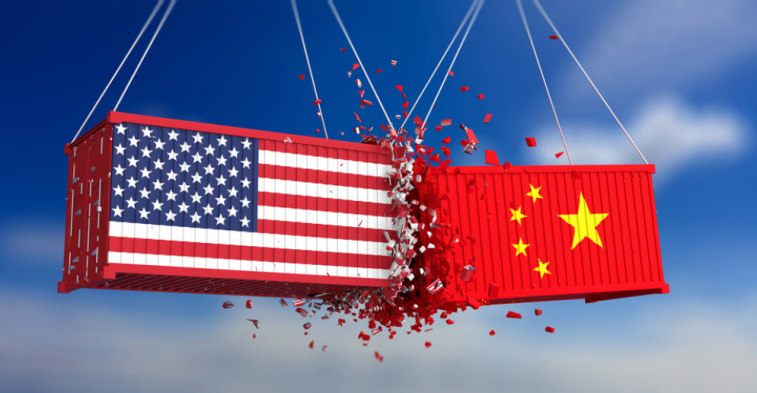

Africa’s position in the global trading order shifted materially in the first quarter of 2026, as a collapsing US preferential framework and a landmark Chinese market-opening initiative simultaneously redrew the continent’s export landscape. The twin developments, Washington’s effective dismantling of the African Growth and Opportunity Act and Beijing’s unilateral elimination of tariffs across all product lines, have forced African governments and businesses to make structural choices about where their trade future lies.
Two Markets, Two Signals
On February 14, President Xi Jinping, in a congratulatory message to the 39th African Union Summit, announced that China would implement a zero-tariff policy on all tariff lines for products from 53 African countries with diplomatic ties with China, effective May 1, 2026. The sole exclusion is Eswatini, which maintains diplomatic recognition of Taiwan. 7.7% year-on-year to a record high. China has remained Africa’s largest trading partner for 16 consecutive years.
The timing is striking. In April 2025, President Trump imposed large reciprocal tariffs on most countries worldwide. These tariffs wiped out most of AGOA’s advantages, and the agreement lapsed on September 30, with Trump showing no inclination to renew it. AGOA exports dropped 32% in the year ending November 2025 compared to 2024. South African auto exports, which had been a major AGOA beneficiary, plunged almost 75% in 2025, from 25,544 vehicles to 6,530.
Then, against the odds, the US Congress passed legislation to extend AGOA until December 31, 2026, retroactively from September 30, 2025. However, the reauthorization does not override the reciprocal tariffs imposed by the Trump administration. As a result, the reciprocal tariffs override the benefits provided under AGOA. The US Supreme Court struck down the larger IEEPA tariffs on February 20, but the White House responded immediately, imposing a 15% surcharge on most imports, effective February 24, 2026, for 150 days.
Beijing Positions Itself as Africa’s Partner of Choice
China’s policy is framed explicitly as a counterweight to Western protectionism. China’s Foreign Minister Wang Yi described the initiative as an arithmetic equation: using the “subtraction” of tariffs to drive the “addition” of trade and achieve the “multiplication” of livelihoods, creating greater opportunities for Africa through China’s vast market.
The policy carries tangible commercial stakes. Middle-income exporters such as Kenya, South Africa, Nigeria, Egypt and Morocco stand to benefit. These countries previously faced Chinese tariffs of up to 25% on processed goods and will now gain duty-free access on the same terms as the poorest African economies.
Products such as cocoa from Côte d’Ivoire and Ghana, coffee and avocados from Kenya, and tangerines and wine from South Africa previously faced tariffs ranging from 8% to 30%. With the implementation of zero tariffs, their competitiveness in the Chinese market will be notably enhanced.
The announcement drew international endorsement. UN Secretary-General António Guterres, during the 39th African Union Summit, highly praised China’s zero-tariff initiative, appealing to all developed countries and nations with large economic potential to take the same measure.
Trade Diversion Limits the Damage… For Now
The macroeconomic picture is more nuanced than the headline disruption suggests. Simulations by the German Institute of Development and Sustainability show that AGOA-eligible countries’ exports to the US fall sharply by 34.7%, but total exports decline by only 1.1%, as trade diversion to other markets offsets over 40% of US losses. China’s zero-tariff initiative will operate on multiple levels: reducing immediate barriers while encouraging deeper structural changes, supporting a transition from raw commodity exports toward value-added production, and creating incentives for investment and standards upgrading.
The African Development Bank has consistently emphasized industrialization as central to economic transformation, noting that manufacturing contributes only 11% to Africa’s GDP on average. The degree to which Africa can convert preferential access into domestic industrial capacity will determine the long-term returns.
Structural Risks Persist on Both Sides
The opportunity carries its own warnings. Africa had a trade deficit with China of $102 billion in 2025, a 65% year-on-year rise. African exports to China remain dominated by minerals and raw materials, such as metallic ores and crude oil. Without domestic industrial policy reform, tariff elimination risks accelerating commodity extraction rather than manufacturing growth. Duty-free access alone does not necessarily change the unbalanced trade picture between China and Africa. The focus on natural resources and minerals in China’s imports from Africa has not shifted according to Brookings.
The selective exclusion of Eswatini underscores the deeper strategic motivations behind Beijing’s trade reforms, a reminder that access to China’s market remains contingent on political alignment. On the US side, industry in Africa is unlikely to reinvest in the jobs, facilities and programs vital for their involvement in AGOA given the extreme short-termism of current US trade policy, with the program set to expire again at year-end absent further legislative action.
Africa enters the second half of 2026 navigating two diverging trade architectures simultaneously. Markets and investors will be watching whether African governments can leverage China’s zero-tariff opening to move up the value chain, rather than simply deepening raw material dependence, while monitoring whether the US produces a durable, long-term AGOA successor capable of restoring the investment certainty the continent’s exporters require. The acceleration of AfCFTA’s operational framework remains the one trade lever fully within Africa’s control.