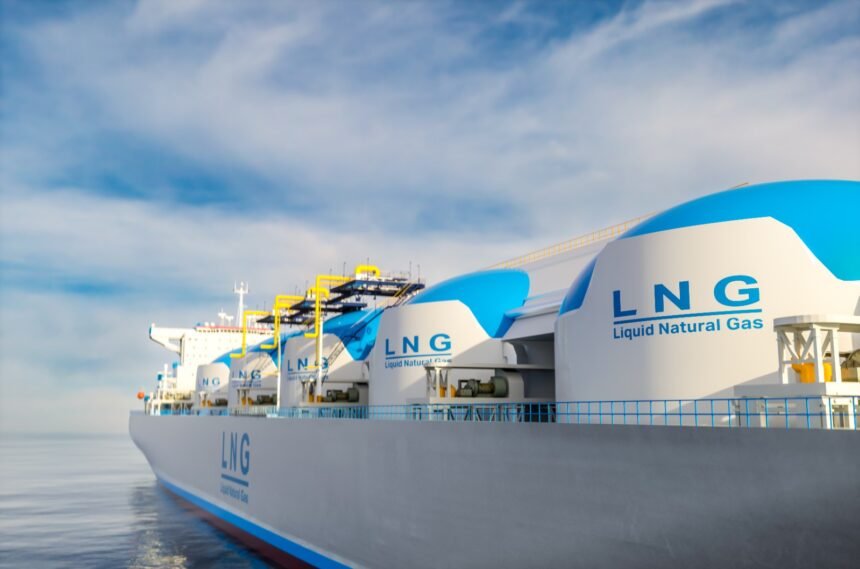

Africa’s liquefied natural gas sector posted its strongest quarterly performance on record in the first three months of 2026, with continental exports rising 27% year-on-year to 11.32 million tons, as infrastructure milestones from Nigeria to the Republic of Congo and the Senegal-Mauritania corridor converged with supply disruptions in the Middle East to accelerate the continent’s role in global energy markets.
A Continent Rewrites Its Place in Global Gas
African LNG exports reached 11.32 million tons in Q1 2026, equivalent to 9.96% of global LNG supply, which totaled 113.6 million tons in the January–March period, according to a report published on April 16 by The Energy Research Unit.
The surge was largely driven by supply disruptions linked to the war in the Middle East, where damage to oil and gas infrastructure and reduced maritime traffic through the Strait of Hormuz forced European and Asian buyers to rapidly adjust sourcing strategies and turn more to Africa for LNG supplies.
Nigeria remained the continent’s dominant exporter. Africa’s largest LNG producer shipped 4.99 million tons in the quarter, a 45% year-on-year increase. Algeria followed with 2.04 million tons.
The most dramatic growth came from newer entrants. Mauritania posted a 1,574% year-on-year increase, shipping 703,000 tons in Q1 2026 compared to just 42,000 tons in the same period of 2025, following the Greater Tortue Ahmeyim project’s commercial export launch with Senegal, BP, and Kosmos Energy. The Republic of Congo nearly doubled its exports, rising 98% to 273,000 tons, propelled by Eni’s Phase 2 expansion coming online ahead of schedule.
Eni, BP and NLNG Drive a New Wave of Capacity
The Congo milestone marked a defining moment for Africa’s floating LNG strategy. In December 2025, Eni announced the start-up of Congo LNG Phase 2 ahead of the planned schedule, with the arrival of the Nguya FLNG unit and the introduction of gas into new offshore infrastructure, targeting the first export cargo in early 2026. Phase 2 brings the Congo LNG project to a total liquefaction capacity of 3 million tons per year, equivalent to 4.5 billion cubic meters annually, drawing on gas resources from the Nené and Litchendjili fields in the offshore Marine XII license.
Eni Chief Executive Claudio Descalzi attended the ceremony marking the first Phase 2 cargo alongside Republic of Congo President Denis Sassou N’Guesso.
We reach a very important milestone thanks to the relationship of trust built with the country’s institutions and local communities,
Descalzi said, adding that Congo LNG highlights Eni’s ability to transform gas resources into strategic value through a cost-competitive project with strong environmental performance.
On the West African coast, the BP-led Greater Tortue Ahmeyim project delivered a continental first. Phase 1 achieved first gas in December 2024 and commercial exports in June 2025, with Phase 2 targeting 2.5–3 million tons per annum capacity, pending a final investment decision. Nigeria’s state-run NLNG is pursuing its most consequential expansion in a generation. The NLNG Train 7 project will boost production capacity by 35%, increasing from 22 to 30 million tons per annum, leveraging Nigeria’s 202 trillion cubic feet of proven gas reserves, the ninth largest in the world.
From 10% to 20%: The Structural Case for Africa’s Growing Share
Africa currently accounts for approximately 9.96% of global LNG exports, with potential to reach 15–20% by 2030 based on planned project developments, supported by the continent’s substantial reserve base and improving infrastructure. Sub-Saharan LNG volumes reached 26.9 million tons in 2024, with 60% destined for Asian markets and 25% for Europe. The Middle East disruptions of early 2026 have accelerated this trajectory, as European buyers deepened long-term offtake negotiations with African producers following years of supply chain vulnerability.
The African Energy Chamber’s State of African Energy 2025 Outlook projects that Africa’s LNG export capacity could approach 175 million tons per year by 2040, with sub-Saharan Africa’s production share rising substantially as North Africa’s relative contribution declines from 66% to 40% of the continental total by 2035. As West and Southwest African producers sit in proximity to both Atlantic and Indian Ocean markets, they can function as swing suppliers, taking advantage of fluctuations in European and Asian LNG spot prices or global supply disruptions, a strategic flexibility that traditional Gulf exporters cannot replicate on the same timescale.
High Breakeven Costs and a Looming Glut Cloud the Outlook
Despite the momentum, structural risks remain acute. A study by the International Institute for Sustainable Development warns that African LNG producers, including Algeria, Senegal, Nigeria, and Mozambique, carry higher breakeven costs compared to major competitors such as the United States and Qatar, making them more vulnerable to price competition in a potential oversupply scenario. Projects still under development in Mozambique, Senegal, and Nigeria face the risk of beginning production in the 2030s, when global demand could be materially lower as the energy transition accelerates.
The domestic monetization challenge remains largely unresolved. While Mozambique, Senegal, and Nigeria anchor global supply ambitions, domestic pipelines, modular LNG, and industrial gas networks will determine whether gas ultimately translates into factories, power generation, and jobs on the continent. Southern Africa faces particular urgency, with declining feedgas flows through the ROMPCO pipeline and a projected supply cliff intensifying from mid-2026. Security concerns continue to shadow East Africa’s flagship projects. Mozambique’s TotalEnergies-led onshore complex remains suspended following the 2021 insurgency, though a restart has been signaled contingent on security stabilization.
Africa’s LNG sector enters the second half of 2026 with undeniable commercial momentum but structurally unresolved questions about long-term demand, domestic value capture, and financing architecture. Investors and policy makers will be watching whether Nigeria’s Train 7, the GTA Phase 2 final investment decision, and Mozambique’s restart timeline can be sequenced fast enough to lock in today’s demand window, before a potential global LNG glut materializes later this decade.