

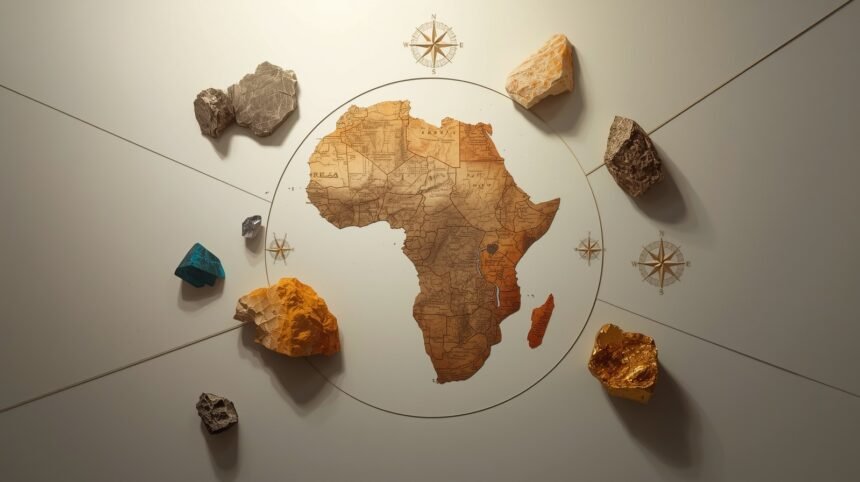
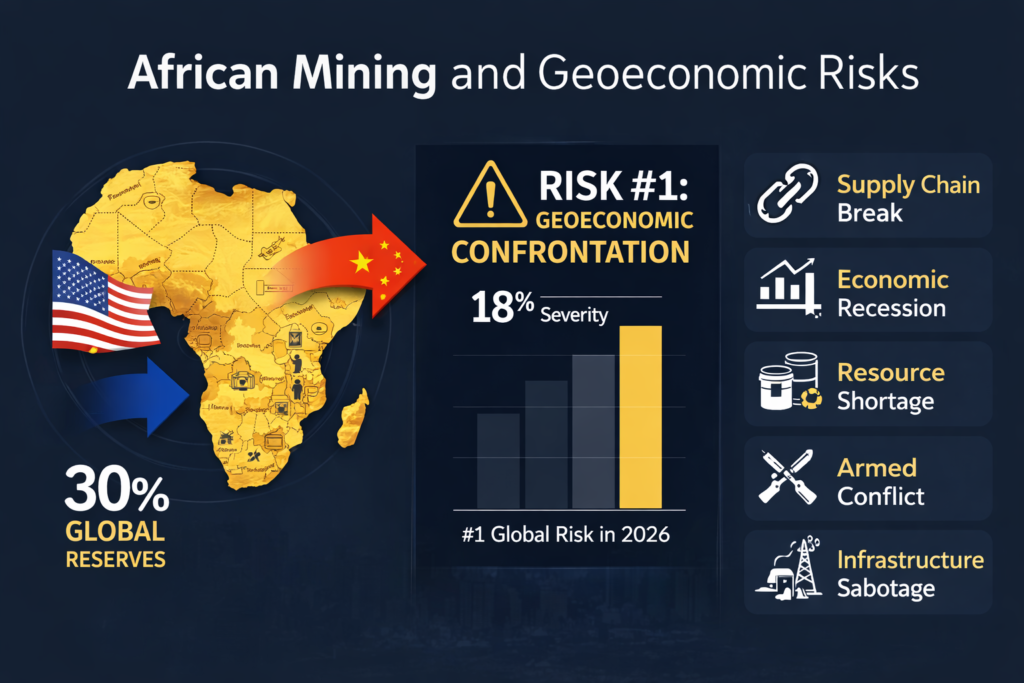
The era of “market-first” mining is dead. According to the World Economic Forum’s Global Risks Report 2026, released just weeks ago, geoeconomic confrontation has officially become the world’s #1 immediate threat. For the first time in 21 years, the weaponization of trade, tariffs, sanctions, and export bans outranks armed conflict as the most likely trigger for a global crisis.
The Weaponization of the Periodic Table
The report confirms a “paradigm shift”: critical minerals are now geopolitical influence weapons. China’s recent export controls on antimony and gallium, paired with the U.S. “Day One” executive orders to dominate non-fuel mineral processing, have left African producers caught in the middle.
Countries not aligned with China or the United States may face pressure to comply with sanction regimes.
The 2026 Global Risks Report
Key players in Africa’s mining sector are no longer just discussing extraction; they are navigating a world where a shipment of cobalt or lithium is a move on a global chessboard.
The numbers are stark:
80% to 90% of global refining for cobalt and rare earths remains concentrated in China.
18% of global experts now view supply chain fragmentation as a systemic threat to 2026 growth.
$170 billion: The amount China has poured into African infrastructure since 2000, creating a “debt-and-dependency” trap that Western initiatives like the Global Gateway are now desperately trying to counter.
Neutrality is Getting Expensive
For the mining sector, the “balancing act” is reaching a breaking point. Countries like the DRC and Zambia are facing intense pressure to pick a side. However, a new African narrative is emerging: “Strategic Autonomy.” “Africa is no longer a passive supplier,” emphasize experts. The goal is to move from “volume-led growth” to “value-led growth.”
By leveraging the current scarcity, African nations are demanding local refineries and processing plants as the price of entry for foreign investors.
The Militarization of Logistics
The 2026 risk map highlights a terrifying new frontier: the physical disruption of infrastructure. From sabotaged undersea cables to blocked maritime straits, the corridors carrying Africa’s wealth are increasingly vulnerable.
Projects like the Lobito Corridor are seen as vital, but they also represent high-value targets in a fragmented world order where 68% of leaders expect a multipolar system governed by “realpolitik” rather than international law.
The 2026 Risk Interconnection
Supply chain disruption is now ranked as the world’s 19th most severe global risk, underscoring growing vulnerabilities in an increasingly fragmented economic order. At the same time, resource nationalism is on the rise, as states move to build “strategic reserves” and tighten control over critical raw materials.
Across Africa, a harsh economic reckoning is unfolding: high debt levels and persistent inflation are forcing governments to sell stakes in mining assets, sometimes back to national authorities themselves, not as a strategic choice, but as a fiscal survival mechanism that risks undermining long-term sovereignty.
In 2026, a mine is no longer just an investment; it’s a fortress. Africa holds the keys to the green transition, but without a unified strategy, it risks being the arena where major powers settle their scores.






Aw, this was an extremely good post. Taking the time and
actual effort to produce a superb article… but what can I say… I put things off a whole lot
and don’t manage to get anything done.
It’s an amazing post in support of all the internet users; they will get benefit from it I am
sure.
Its like you read my mind! You appear to know so much about this, like you wrote the book
in it or something. I think that you could do with
some pics to drive the message home a little bit, but
other than that, this is wonderful blog. An excellent read.
I’ll certainly be back.
Hey there just wanted to give you a brief heads up and let you know a few of the images aren’t loading
properly. I’m not sure why but I think its a linking issue.
I’ve tried it in two different internet browsers and
both show the same results.
Pretty! This has been an incredibly wonderful post.
Thanks for supplying this info.
Wonderful items from you, man. I have bear in mind your stuff previous to and you are simply extremely great.
I really like what you have bought here, really like what you’re stating and the way during
which you say it. You’re making it entertaining and you still care for to keep it sensible.
I can’t wait to learn much more from you. This is really a tremendous website.
Wow, amazing blog layout! How long have you been blogging for?
you make blogging look easy. The overall look of your site is fantastic,
as well as the content!
Hello! This is kind of off topic but I need some advice from an established blog.
Is it difficult to set up your own blog? I’m not very techincal
but I can figure things out pretty quick. I’m thinking
about making my own but I’m not sure where to start.
Do you have any ideas or suggestions? Thank you